A preliminary Pentagon investigation has concluded that the United States was responsible for the February 28 Tomahawk missile strike that hit the Shajareh Tayyebeh elementary school in Iran, killing at least 175 people -- most of them children. The finding attributes the strike to a targeting error rather than an intentional attack on the school. The review is ongoing, but initial results indicate a failure in the targeting chain caused the missile to strike the building. The strike on the all-girls school has been the single most politically damaging incident of Operation Epic Fury, drawing global condemnation from allies and adversaries alike and intensifying bipartisan calls in Congress for greater oversight of the war.
The school was initially reported to have killed 148 children. The toll has since risen to 175. BBC Verify previously confirmed a US Tomahawk struck the site, contradicting early Pentagon ambiguity.
All 32 members of the IEA have agreed to release 400 million barrels from emergency oil stockpiles -- more than double the previous record release after Russia's 2022 invasion of Ukraine. The decision responds to what the IEA called supply disruptions "unprecedented in scale" caused by the Iran war, which has virtually halted oil exports through the Strait of Hormuz, the passage carrying 25% of global seaborne oil. Despite the move, analysts warn it is only a short-term fix. "Once you release them, they don't exist," said Nick Butler, former head of strategy at BP. Oil prices remain roughly 25% higher than before the war, and the IEA's executive director said there are "few options" to address a separate 20% slump in LNG supplies caused by the conflict.
IEA members must keep 90 days of oil imports in reserve. Collectively they hold 1.2 billion government barrels plus 600 million in industry stocks. This release drains a third of government holdings.
Anthropic has filed two federal lawsuits -- in a California district court and the DC Circuit -- challenging the Trump administration's blacklisting of its AI technology across all federal agencies. The company argues it exercised its First Amendment rights by refusing to let Claude be used for fully autonomous lethal warfare and mass domestic surveillance, and that the government retaliated by designating it a "Supply-Chain Risk to National Security." The White House called Anthropic a "radical left, woke company." Supporting briefs were filed by the EFF, the Cato Institute, and a group of Google and OpenAI employees who warned that "mass domestic surveillance powered by AI poses profound risks to democratic governance." CEO Dario Amodei said the company supports AI for lawful intelligence missions but current models are not reliable enough to power fully autonomous weapons.
The standoff began in late February when the Pentagon demanded Anthropic remove restrictions on military AI use. After Anthropic refused, Trump ordered all agencies to cease using its technology.
SpaceX is preparing for what analysts say will be the largest IPO in history, targeting a summer listing that could raise $50 billion at a valuation exceeding $1.75 trillion. The listing follows SpaceX's February acquisition of Elon Musk's AI venture xAI in a $1.25 trillion combined-entity deal -- itself the largest merger by valuation ever. "Whether we're talking about the market cap or the size of the IPO, both look like they're going to be the biggest in history," said Jay Ritter, a University of Florida professor who has tracked every major US IPO since 1975. If successful, the combined entity would rank among the world's ten most valuable public companies. The offering is the first of several mega-IPOs expected to hit US markets in 2026 after a quiet 2025 in which 90 companies raised a combined $40 billion.
SpaceX operates the Falcon 9 rocket, Starlink satellite internet, and the Starship launch system. It has never been publicly traded despite being valued among the world's most valuable private companies for years.
Google has completed its acquisition of Wiz, the cloud security startup, in the largest cybersecurity deal in history. The acquisition gives Google a major platform for securing multi-cloud environments as AI-powered applications create new attack surfaces. Wiz will remain a multi-cloud platform supporting AWS, Azure, GCP, and OCI -- meaning enterprise customers won't be locked into Google's ecosystem. The combined entity integrates Wiz with Mandiant's threat intelligence and Google's broader security platform. In the year since the deal was announced, Wiz kept shipping: launching AI security agents, an exposure management platform, and hardened container base images. Most Fortune 100 companies and leading AI labs are Wiz customers.
Google originally tried to acquire Wiz in 2024 for $23 billion, but Wiz walked away to pursue an IPO. The company returned at a higher $32 billion valuation after rapid growth.
German researchers have demonstrated the first recovery of meaningful brain function from completely frozen and thawed tissue. A team led by neurologist Alexander German at the University of Erlangen-Nuremberg used vitrification -- cooling tissue fast enough to trap molecules in a glass-like state before ice crystals form -- to preserve 350-micrometer-thick mouse hippocampus slices at -196 degrees C. After days of storage at -150 degrees C, thawed brain slices showed intact neuronal membranes, no metabolic damage, near-normal electrical responses to stimuli, and preserved long-term potentiation, the synaptic strengthening process underlying learning and memory. Applications like whole-organ cryopreservation remain distant, but the study, published in PNAS, hints at future paths to protecting brains during disease or severe injury.
Previous cryopreservation attempts preserved cells structurally but failed to restore functional processes like neuronal firing and synaptic plasticity. Ice crystals puncture the brain's delicate nanostructure.
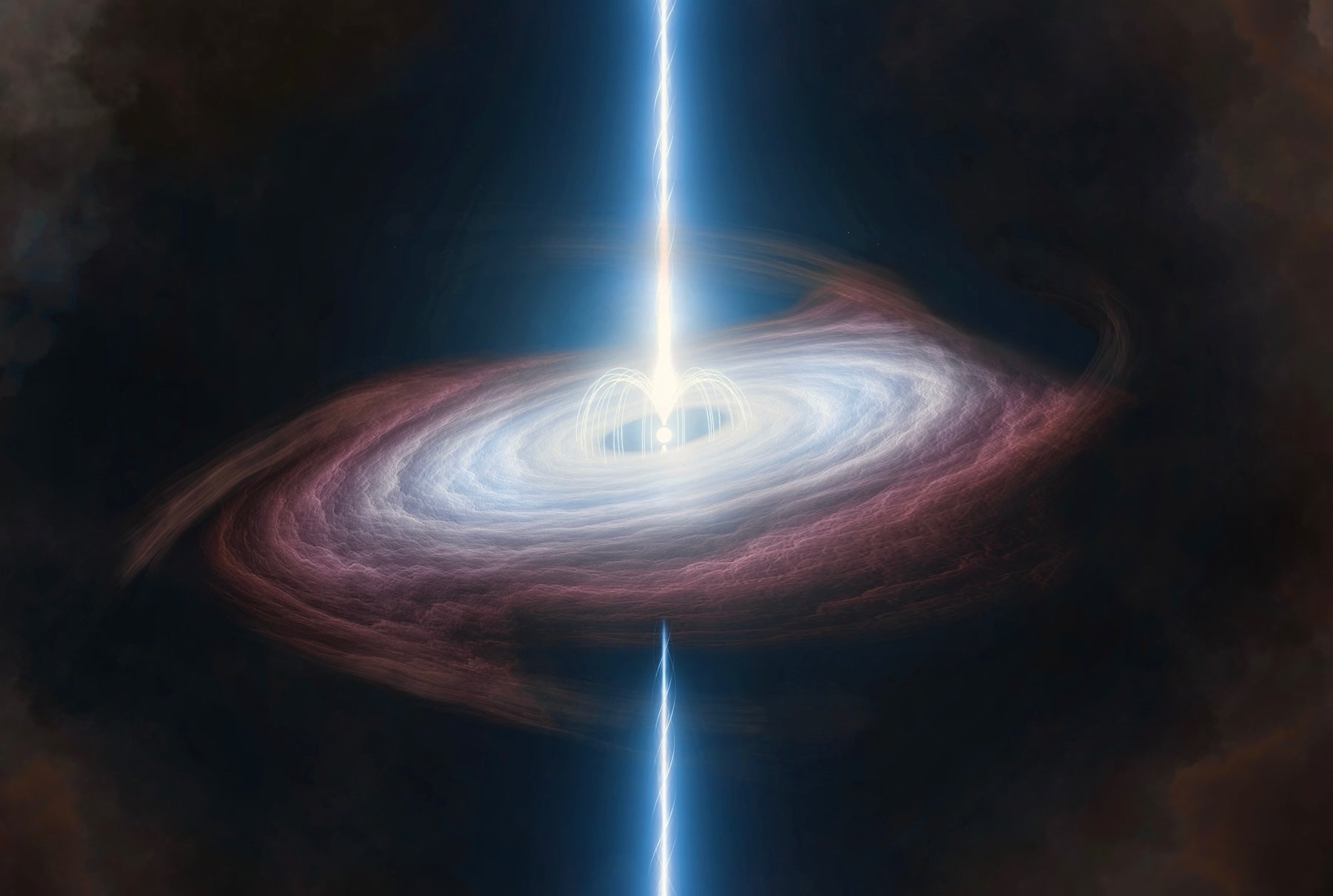
Astrophysicists have solved a two-decade mystery about what powers superluminous supernovae -- stellar explosions more than ten times brighter than normal that can shine for months. In a paper published today in Nature, a team led by Joseph Farah at Las Cumbres Observatory and UC Santa Barbara found the signature of a newborn magnetar driving the explosion. The key evidence: a wobbling pattern in the supernova's brightness caused by Lense-Thirring precession, an effect from Einstein's general relativity where a spinning massive object drags space-time around it, sweeping radiation beams like a tilted lighthouse. This marks the first time scientists have witnessed a magnetar's birth -- connecting these ultra-bright explosions to the most extreme objects in the cosmos, neutron stars with magnetic fields up to 1,000 times stronger than typical.
Superluminous supernovae were first observed in the early 2000s. Magnetars were theorized as the power source, but direct evidence was lacking until this wobbling brightness pattern confirmed it.
Seventeen Democratic-led states have filed suit against the Trump administration over a new survey called ACTS that requires colleges to report years of admissions, financial aid, and student performance data broken down by race. The states argue the survey is designed to build cases for stripping federal funding from schools the administration suspects of still practicing affirmative action in violation of the Supreme Court's 2023 ruling. The lawsuit challenges the survey as exceeding executive authority and imposing undue burdens on educational institutions. This is the latest front in the broader battle over race in higher education since the Court struck down race-conscious admissions. The action comes alongside a separate dispute over Title IX funding threats against San Jose State University involving a transgender student-athlete.
The Supreme Court's 2023 Students for Fair Admissions ruling banned race-conscious admissions. The Trump administration has aggressively pursued enforcement, threatening funding cuts at institutions it suspects of non-compliance.
Jingan Technology, a Hangzhou-based defense firm that provides intelligence services to the PLA, claims its AI-powered monitoring system detected radio signals from American B-2 stealth bombers during the March 1 strikes on Iran. The company's Jingqi system integrates satellite imagery, aviation trajectory data, and public military records, using AI to analyze patterns. Jingan says the system concluded as early as January that the US had begun its largest Middle East military buildup in nearly two decades, surpassing Iraq War-era deployments. If verified, the claim would raise significant questions about the B-2's stealth characteristics, designed to evade radar and electronic detection. However, the claims come from a private contractor promoting its capabilities, and no independent verification has been published.
The B-2 Spirit is designed to penetrate heavily defended airspace undetected. Any credible signal interception would be significant for global defense planning, though self-promotional claims from defense contractors require skepticism.
Astrid Eichhorn, a physicist at Heidelberg University, has spent a decade advancing asymptotic safety -- a theory of quantum gravity proposing that at the tiniest scales, space-time becomes fractal-like and the laws of physics stop changing. Where string theorists replace particles with vibrating strings and loop quantum gravity theorists dissolve space-time into discrete chunks, Eichhorn's approach preserves both fields and continuous space-time but predicts they take on a self-similar structure at the Planck scale. Her recent work has shown the quantum fields in nature may have fluctuations that balance in just the right way to stabilize physics at shorter scales, connecting Planck-scale physics to experimentally accessible energy ranges -- a notoriously difficult task for any quantum gravity theory. The idea traces to a 1976 proposal by Nobel laureate Steven Weinberg.
The three main approaches to quantum gravity are string theory, loop quantum gravity, and asymptotic safety. Eichhorn's work has gained traction by connecting the theory to observable physics.