Oil prices jumped sharply on Wednesday despite the IEA's agreement the previous day to release a record 400 million barrels from emergency stockpiles -- the largest coordinated release in the agency's history. Brent crude briefly topped $121 per barrel as Iran escalated attacks on commercial shipping in the Strait of Hormuz, the narrow waterway through which roughly 20% of the world's oil passes daily. Iranian naval forces have reportedly harassed or attacked at least four tankers this week, and insurers are now charging record war-risk premiums for vessels transiting the strait. The IEA release was supposed to calm markets, but traders say the physical disruption to shipping routes matters more than promises of future supply. The price surge compounds pressure on the US economy heading into midterm season, with gasoline prices already at multi-year highs across much of the country. Kevin O'Leary called high oil prices the 'granddaddy' issue for the 2026 midterms.
The IEA coordinated a 400-million-barrel emergency release among all 32 member nations on Tuesday -- more than double the previous record set during the 2011 Libya crisis. Oil prices had already been climbing since US-Israeli strikes on Iran began on March 2, disrupting major oil-producing infrastructure around Tehran.
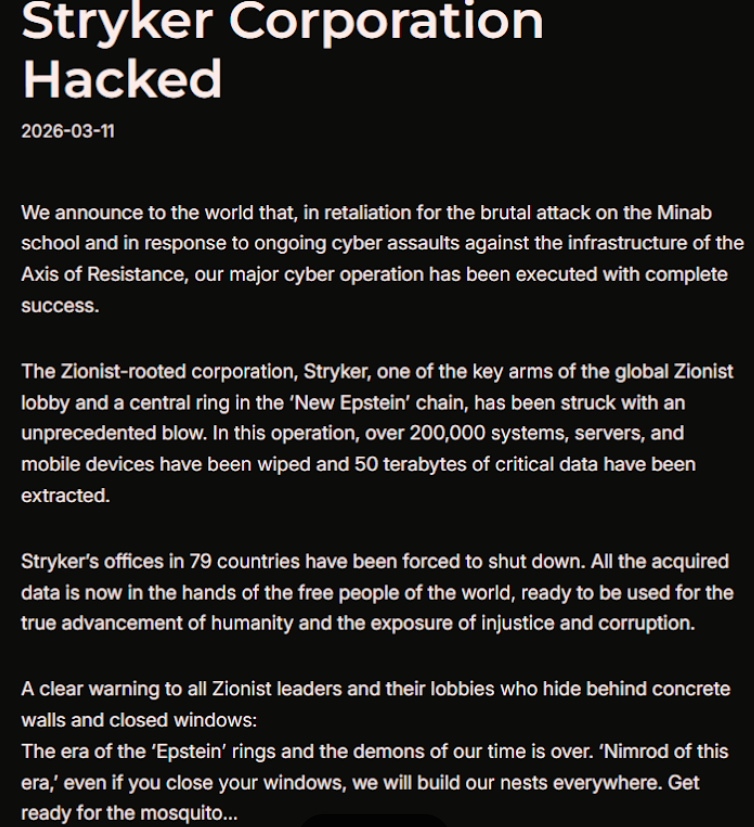
An Iran-linked hacktivist group called Handala claimed responsibility for a devastating data-wiping attack against Stryker, a $25-billion-a-year medical device company based in Michigan. The group says it erased data from more than 200,000 systems, servers, and mobile devices across Stryker's offices in 79 countries. In Ireland -- Stryker's largest hub outside the US -- more than 5,000 workers were sent home, and employees reported that any device with Microsoft Outlook had been remotely wiped. A source told KrebsOnSecurity the attackers appear to have hijacked Microsoft Intune, a cloud management tool, to issue mass remote-wipe commands to all connected devices. The attack is already affecting healthcare supply chains: one university medical system reported being unable to order surgical supplies normally sourced through Stryker. Handala said the attack was retaliation for the February 28 missile strike on an Iranian school that killed at least 175 people, most of them children.
Handala is assessed by Palo Alto Networks as a persona of Void Manticore, a group affiliated with Iran's Ministry of Intelligence and Security (MOIS). The group surfaced in 2023 and primarily targets Israeli entities, but has expanded operations since the US-Iran conflict began. Stryker makes surgical equipment used in virtually every US hospital.
Pentagon officials told lawmakers during a Tuesday briefing that the approximate cost of military operations against Iran -- dubbed Operation Epic Fury -- has reached $11.3 billion through the first six days of action. The figure, disclosed by a source familiar with the briefing, covers munitions expenditures, aircraft carrier operations, aerial refueling, and logistics but does not include long-term costs like equipment replacement or veterans' care. For context, the US spent roughly $14.5 billion per month at the peak of the Iraq War in 2008. A separate Senate Finance subcommittee hearing on Wednesday saw bipartisan alarm over the fiscal implications, with senators warning that war costs are compounding an already dire national debt situation. The disclosure comes as the administration has not yet submitted a supplemental funding request to Congress.
US and Israeli forces launched strikes against Iran on March 2, primarily targeting military infrastructure and oil facilities around Tehran. The operation has involved aircraft carriers, B-2 bombers, Tomahawk cruise missiles, and extensive aerial operations. Congress has not authorized the military action, and legal challenges are pending.
Italian Prime Minister Giorgia Meloni delivered a forceful rebuke of the US-Israeli military campaign in Iran during a speech before Italy's Parliament on Wednesday, calling the strike on an Iranian elementary school a 'massacre' that fell 'outside the scope of international law.' Meloni expressed 'firm condemnation' of the attack, which killed at least 175 people -- most of them children -- on February 28. Her remarks represent the sharpest criticism yet from a major NATO ally and come amid growing European discontent over the war. Meloni, who leads a right-wing coalition government and has generally maintained warm relations with the Trump administration, appeared to be signaling that the school strike had crossed a line European leaders cannot defend publicly. The Pentagon's own preliminary investigation has concluded the United States was responsible for the Tomahawk missile strike that hit the school.
Meloni leads Italy's most right-wing government since World War II and has been a reliable US ally on defense issues. Her public break over the school strike follows similar statements from other European leaders and a BBC Verify investigation that confirmed US responsibility for the missile hit.
OpenAI is under pressure from both employees and legal experts over its deal to supply AI technology to the Pentagon's classified networks. On Saturday, robotics team lead Caitlin Kalinowski resigned, calling the agreement 'rushed without guardrails defined.' The deal was announced hours after Anthropic refused to remove restrictions on autonomous weapons and mass surveillance from its own government contract -- a refusal that led the Trump administration to declare Anthropic a national security supply chain risk and ban it from federal use. Analysts say OpenAI's published contract terms use 'surveillance' in a narrow legal sense that may still permit mass data processing and analysis of Americans' information. Brad Carson, a former Army under secretary, warned that national security lawyers interpret the word very differently than ordinary people. The government has spent years purchasing vast quantities of consumer data, and LLMs now make it possible to extract structured insights from that data at scale -- potentially sidestepping the spirit of surveillance prohibitions without violating their letter.
Anthropic was blacklisted by the Pentagon in early March after refusing to drop contract clauses prohibiting autonomous weapons and mass surveillance. OpenAI announced its own Pentagon deal the same day, claiming it maintained the same red lines -- but the published terms have drawn skepticism from legal experts.
China has significantly stepped up land reclamation on a disputed shoal in the South China Sea -- what may be the most significant such project since Beijing officially halted island-building more than a decade ago. Satellite imagery published Monday by researcher Damien Symon of The Intel Lab shows Antelope Reef in the Paracel Islands has expanded substantially, with more than 30 vessels -- believed to be dredgers and construction support ships -- visible in its lagoon. The reef sits about 400 km from Sanya on China's southern coast and roughly 1,000 km from Da Nang, Vietnam. It is also about 90 km from Woody Island, where China maintains its administrative hub for the South China Sea. The timing is notable: the US has redeployed significant naval assets from the Pacific to the Middle East for operations against Iran, potentially creating a window of reduced American presence in the region.
China built and militarized artificial islands in the South China Sea between 2013 and 2016, drawing international condemnation. Beijing officially announced a halt to reclamation in 2016 after a UN tribunal ruled its expansive territorial claims had no legal basis. The Paracel Islands are also claimed by Vietnam and Taiwan.
Journalist Julia Angwin has filed a class-action lawsuit against Superhuman, Grammarly's parent company, over its 'Expert Review' AI editing feature -- which used the names and identities of real journalists and academics to lend credibility to AI-generated writing suggestions without their knowledge or consent. The complaint alleges violations of privacy and publicity rights. Angwin learned she was included in the system through reporting by Casey Newton of Platformer; The Verge subsequently found that several of its own staff, including editor-in-chief Nilay Patel, were also listed as 'experts.' Superhuman CEO Shishir Mehrotra announced Wednesday that the feature has been disabled entirely, after initially offering only an opt-out email address. He apologized, saying the company 'fell short' and would 'rethink our approach.' The lawsuit follows weeks of backlash since The Verge and other outlets first exposed the feature in early March.
Grammarly launched Expert Review in August 2025, presenting AI-generated editing feedback as if authored by named journalists and academics. The feature was first exposed in early March 2026, prompting initial backlash that Grammarly met with an opt-out email. The lawsuit escalates the matter to a legal challenge over identity rights.
A federal government watchdog has found that the Trump administration's Department of Education significantly relaxed oversight of student loan servicers -- the companies responsible for managing repayment on behalf of tens of millions of federal borrowers. The report describes how the department eased compliance assessments that had previously held servicers accountable for errors, delays, and borrower mistreatment. The administration argues that just because one assessment methodology changed does not mean oversight has weakened, but advocates and Democratic lawmakers say the shift leaves borrowers more vulnerable to mismanagement at a time when student loan policy is already in flux. The report is notable context as the department simultaneously faces multiple lawsuits over its handling of income-driven repayment plans and loan forgiveness programs.
Federal student loan servicers -- companies like MOHELA and Nelnet -- process payments, handle applications for repayment plans, and serve as the primary point of contact for the roughly 43 million Americans with federal student debt. Past watchdog reports have documented widespread servicer errors that cost borrowers money.
The Trump administration is moving to reclassify federal employees who review and approve research grants under a new employee category that would strip their civil service job protections -- a significant escalation of the Schedule F initiative that could reshape how billions of dollars in scientific funding are awarded. The reclassification would make grant reviewers at-will employees who can be fired without the procedural safeguards that currently insulate them from political pressure. Critics warn this could politicize the grant-making process at agencies like the NSF and NIH, where peer review has traditionally operated at arm's length from political appointees. Supporters argue it would increase accountability and allow faster removal of underperforming staff. The move comes as the administration has already used DOGE-driven reviews to cut federal grants it considers ideologically motivated.
Schedule F, first proposed in 2020 and revived by the current administration, converts certain federal policy roles from competitive civil service positions to at-will appointments. Grant reviewers evaluate scientific proposals using peer review and recommend funding decisions worth billions annually.
Our sun was born 4.6 billion years ago near the crowded center of the Milky Way and then migrated roughly 10,000 light-years outward to reach its current quiet suburban neighborhood. Two studies published today in Astronomy and Astrophysics now show the sun did not make this journey alone -- thousands of chemically identical 'solar twin' stars made the same trip. The key puzzle is a massive rotating bar of gas, dust, and stars cutting through the galactic center, which creates a gravitational barrier called the corotation barrier. Simulations suggest only about 1% of stars born at the sun's original location could have breached this barrier within 4.6 billion years. Yet Tokyo Metropolitan University astronomer Daisuke Taniguchi and colleagues found that thousands of solar twins successfully crossed it, suggesting a large-scale migration wave rather than individual lucky escapes. The mechanism behind such collective galactic migration remains an open question.
Stars born closer to the galactic center have higher concentrations of heavy metals, which serves as a chemical fingerprint of their birthplace. The sun's metal content does not match what would be expected for a star formed at its current distance from the center, which is how astronomers first deduced it had migrated.
Even a single course of antibiotics can leave lasting marks on the gut microbiome that persist for years, according to a study of nearly 15,000 adults in Sweden published today in Nature Medicine. Researchers cross-referenced stool samples with Sweden's national prescription registry to compare the gut microbiomes of people who had taken antibiotics in the prior eight years with those who had not. People with no antibiotic exposure had about 350 unique bacterial species in their gut on average; those with any exposure had fewer. The damage varied dramatically by drug. Clindamycin, prescribed for skin and dental infections, was the most disruptive -- each course corresponded to about 47 fewer detected species. Fluoroquinolones, commonly used for urinary tract infections, were linked to about 20 fewer species. Jotham Suez, a microbiome researcher at Johns Hopkins not involved in the study, called the scope 'impressive' and noted it provides the clearest picture yet of long-term antibiotic effects on gut diversity.
The gut microbiome -- the community of trillions of bacteria living in the digestive tract -- influences digestion, immune function, and even mental health. Reduced microbial diversity has been linked to conditions including obesity, inflammatory bowel disease, and susceptibility to infections like C. difficile.
A new protocol called s@ (pronounced 'sat') proposes decentralized social networking where each user's data lives on their own static website -- no servers, no relays, no algorithms. Users publish encrypted posts as JSON files on any static hosting service (the reference implementation uses GitHub Pages), and a browser-based client aggregates feeds from people you follow. The encryption model uses X25519 key pairs and XChaCha20-Poly1305 symmetric encryption, with per-follower key envelopes so only mutual follows can read each other's posts. Unfollowing someone triggers key rotation that locks them out. The FAQ is refreshingly honest: 'Does this scale? No! Neither does friendship.' The project hit 271 points on Hacker News with 119 comments. Unlike Mastodon or Bluesky's AT Protocol, s@ eliminates all intermediate infrastructure -- there are no federation servers or firehoses, just static files and browser-side decryption.
The decentralized social networking space includes Mastodon (federated servers), Bluesky's AT Protocol (relays and firehoses), and Nostr (cryptographic relays). s@ takes the most radical approach by eliminating all server-side logic entirely, trading scalability for true self-sovereignty.
China has pledged to raise grain output to record levels over the next five years as part of a sweeping food-security plan announced during the Two Sessions, the annual legislative meetings that concluded this week. The push comes as geopolitical shocks from the US-Israeli war on Iran disrupt global supply chains and energy markets, underscoring Beijing's long-standing anxiety about its dependence on imported food and energy. China imports significant quantities of soybeans, corn, and other staples, and the current oil price surge is raising costs for fertilizers and agricultural transport. The new targets include expanding arable land, investing in seed technology, and reducing food waste -- themes that have appeared in previous five-year plans but are now backed by more ambitious numerical targets. The announcement signals that Chinese leaders view food self-sufficiency as a national security priority on par with semiconductor independence.
China feeds roughly 18% of the world's population on about 9% of its arable land. The country is the world's largest importer of soybeans and a major buyer of corn and wheat. Previous food-security pushes have focused on the 'red line' of maintaining at least 120 million hectares of farmland.
The conventional wisdom that the US war on Iran weakens China by destabilizing its primary oil supplier may be dangerously wrong -- strategic overreach could actually hand Beijing the advantage, argues a National Review analysis. While Iran supplies a significant share of China's crude oil imports, the piece contends that a prolonged US military commitment in the Middle East diverts naval assets and diplomatic attention away from the Indo-Pacific, where China faces its most consequential strategic competition. Beijing may also benefit from discounted Iranian oil on a disrupted global market, deeper ties with a post-war Iran grateful for Chinese diplomatic support, and the spectacle of America's allies publicly breaking with Washington over civilian casualties. The argument is not that the war is unjustified, but that failing to weigh its second-order effects on great-power competition could produce a pyrrhic victory.
China has positioned itself as a neutral mediator in the Iran conflict while calling for a ceasefire. Meanwhile, the US has redeployed significant Pacific Fleet assets to the Middle East, and Beijing has accelerated South China Sea island-building during this period of reduced American presence.
Senator Josh Hawley (R-Mo.) introduced legislation on Wednesday to revoke the FDA's approval of mifepristone, the most commonly used abortion medication in the United States. The bill would direct the FDA to withdraw its 2000 approval of the drug, effectively banning medication abortion nationwide regardless of state-level protections. Mifepristone is used in more than half of all US abortions, and its availability has been a central battleground since the Supreme Court overturned Roe v. Wade in 2022. The bill faces long odds in the current Congress, where it would need 60 Senate votes to overcome a filibuster, but it signals that some Republicans are pursuing a federal approach to restricting abortion rather than leaving the issue to states. Hawley framed the bill as a response to what he called the FDA's failure to adequately study the drug's long-term safety.
Mifepristone was approved by the FDA in 2000 and is used in combination with misoprostol for medication abortion. The Supreme Court unanimously rejected a challenge to mifepristone's approval in 2024, ruling the plaintiffs lacked standing, but did not address the drug's safety or the FDA's approval process on the merits.